

Earlier in my career I helped build and manage an event-driven platform alongside a legend. We invested in change—deals, restructurings, and other catalysts that transformed businesses. To this day, I still closely monitor corporate events and deal activity. It helps me gauge market stress and Board confidence, manage risk, and occasionally uncover unique investments.
Which brings me to Curaleaf/Aurora—a live situation directly in my sandbox. So for this SESH, we’re back on the desk: we’ll break down the deal, Curaleaf’s rationale, the likely event path, and what the spread is signaling.
It’s written for investors, but operators should pay attention too—deals reveal strategic roadmaps and what competitors are willing to do to get there.
Paying subs will also see in the final chapter the various ways to express a view on the transaction—and exactly how I’m expressing mine.
There’s something in here for everyone: whether you’re allocating risk capital, operating in the value chain, or perhaps waiting in the wings as ACB’s potential “white knight.”
So roll up something cerebral and let’s dive in. Summer reset is officially over.
Welcome to SUNDAY SESH.
1/ SITUATION OVERVIEW
I’ve previously argued Cannabis 3.0 will be based on architecture. Unlike Cannabis 2.0 based on bifurcation, this next phase will highlight how each survivor—battle scars and all—proactively architects its future.
Curaleaf’s move on Aurora is the latest example. On August 11th, CEO Boris Jordan pursued the first cannabis “bear hug” in nearly a decade—ultimately escalating into a hostile bid for Aurora Cannabis (“ACB”) to scale its European playbook.
Let’s start with how we got here:
June 11: Aurora reports Q4/FY’26 results. Despite a strong year—revenue and EBITDA grew 18% and 32%—Q4 weakened, and management warned FY’27 would absorb lower reimbursement rates and continued investment. ACB fell ~20% to ~$2.75, then drifted toward $2.50 by mid-July. While ACB had turned the corner starting in 2023—led by Canadian rationalization and an explosion in European exports—its stock remained trapped in a two-year downtrend. ACB’s stock has fallen ~65% from its May 2024 high of ~$9/share. Importantly, ACB was debt-free, sitting on ~$1.40/share of cash and valued at ~3x FY’26A EBITDA. Too cheap—even despite the ‘27 reset—but no one cared. Maybe you did.
June 23: Curaleaf (“CURA”) made its first private approach to ACB. CEO Boris Jordan sent ACB CEO Miguel Martin a letter proposing a combination and requesting an NDA for reciprocal due diligence.
July 7: CURA followed with a second proposal. ACB disputed CURA’s claim that it refused to engage, noting that terms did not specify the cash/stock mix.
July 24: According to ACB, its lead independent director remained in contact with Jordan. The private process was still alive.
August 5: ACB reports Q1 FY’27. Revenue fell 9% YoY, adjusted EBITDA fell ~70% to C$3.4 MM, and FCF swung slightly negative. But the asset CURA cares about kept performing: international medical revenue grew mid-teens driven by Germany. ACB expected sequential improvement, and its balance sheet remained pristine. Stock didn’t do much, still ~$2.75/share.
August 11: Boris takes his offer directly to ACB shareholders—a very interesting move to say the least. CURA announced its intention to make an unsolicited offer of 0.3463 Curaleaf shares plus $0.75 cash per ACB share, valued at $4.00—a 45% premium to ACB’s 30-day VWAP. Importantly, this was still only an intention to bid: no tender offer, no takeover-bid circular, no statutory clock. By mid-day, Boris was already on TV saying ACB was his first choice, but he had other options. My view: Boris was waking up ACB’s Board, while at the same time probing if CURA shareholders would revolt if it did a deal of this size.
August 11: Later that day, Aurora announced it had formed a special committee and flagged a term absent from CURA’s approaches: total consideration would be capped at $5.00 per ACB share. Translation: capped upside with unlimited downside.
August 18: CURA formally launched the bid on the same terms, filed its offer and takeover-bid circular, and took the proposal directly to shareholders. This is the real event date: the bid is live and the statutory clock has started.
August 19: CURA escalated the public campaign, attacking Aurora’s restructuring record and emphasizing the value of ACB’s EU-GMP asset base.
August 19: Aurora went on offense, acquiring Internode Pharma Limited and HAP Pharma Limited—to deepen its distribution in the UK medical market. The deal requires only a small amount of incremental capital but the timing is notable. Perhaps this is why ACB didn’t have time to engage? Perhaps ACB is simply giving CURA the “finger”?
2/ KEY TERMS
Here are the key terms of the deal:
Consideration: Receive 0.3463 CURA shares + $0.75 cash per share, unchanged from the August 11 proposal.
Cap: Total consideration capped at $5.00 per ACB share. If CURA appreciates to breach the cap under the specified 20-day VWAP mechanism, the exchange ratio gets reduced. In other words, ACB participates in CURA upside—but only to $5.00 while being exposed to CURA downside.
105-day clock: Under Canada’s takeover-bid regime, the offer must remain open for at least 105 days, putting the current expiry at Dec 1st, unless shortened under applicable rules or extended. Importantly, this is an offer expiry date—not a traditional merger-agreement “drop-dead” date.
Shareholder Thresholds: The bid requires more than 50% of non-affiliated shares to tender, but CURA imposed a higher 66⅔% fully diluted minimum tender condition, alongside customary regulatory and material adverse effect protections. If the conditions are met or waived, the offer must generally remain open for at least another 10 U.S. business days, after which Curaleaf can proceed toward a second-step acquisition.
No Financing or Diligence Outs: The bid is not subject to financing or due diligence.
Regulatory Approvals: Transaction is conditioned on required regulatory clearances, including Canadian Competition Act clearance and applicable cannabis, foreign-investment, and other governmental approvals across relevant jurisdictions.
3/ STRATEGIC RATIONALE
The strategic rationale is unusually clean. Curaleaf already has U.S. scale and a growing international platform. Aurora brings the harder-to-build piece: scaled international medical revenue, scarce EU-GMP capacity, and excess cash.
Accelerates International Mix. Folding in Aurora would push international to roughly 21% of pro forma revenue (from ~15%) before revenue synergies—a meaningful milestone that’s critical to CURA’s investment story.
Scarce Regulated Supply. ACB adds roughly 50 tons of annual EU-GMP capacity, including Safari. In Europe, GMP certification is part of the pharmaceutical regulatory infrastructure required to manufacture and import medical products. Recreating that footprint today would require substantial capital, time, regulatory approvals, and execution risk—making the replacement cost meaningfully higher than the headline EV CURA is paying (in our judgement). Aurora’s existing platform is the survivor of more than C$1BN of capex plus billions of historical M&A (mostly equity, however).
Creates Verticality. Curaleaf already owns distribution, pharmacy, clinic, and patient-access infrastructure across Germany, the UK, Poland, and other markets. ACB gives it more owned supply to push through that network, improving control over availability, quality, cost, and ultimately margin.
Meaningful Synergies. Curaleaf expects at least $40 MM of annual cost synergies, equal to roughly 15% of its ~$274 MM LTM adjusted EBITDA, plus upside from genetics, cultivation, procurement, and supply-chain optimization. The combined company would exceed $1.5 BN of LTM revenue and ~$350 MM of adjusted EBITDA (with synergies).
Multiple Arbitrage. Curaleaf is effectively using the richest currency in U.S. cannabis—roughly 12x LTM adjusted EBITDA—to buy Aurora at a fraction of that multiple. At the ~$4.00 headline offer, Curaleaf is paying roughly 3.5x FY26A EBITDA before synergies. Add the announced synergies and the effective multiple falls closer to ~2x.
Credit Accretive. The transaction should reduce pro forma net leverage while giving CURA access to valuable scarce assets. We have net leverage declining roughly half a turn.
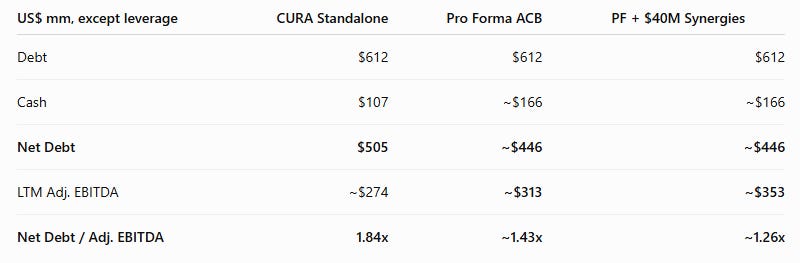
That last point matters. Curaleaf isn’t simply using a higher-valued stock to buy a lower-valued asset—it may be able to improve the balance sheet while doing it and get access to additional scarce cannabis capital.
Another aspect worth considering: Aurora management can ride off into the sunset with a respectable “golden parachute.” After 5+ years fighting through cannabis, I imagine many executives would closely examine the deal, even if it means losing the job.
4/ EVENT PATH
On August 19, ACB urged shareholders to take no action while the Special Committee evaluates the offer. That is not yet a formal rejection; the Board says its recommendation will follow within 15 days.
Canadian takeover rules give the target board time to respond and shareholders time to decide. Curaleaf’s offer expires at 5:00 p.m. Mountain Time on December 1, unless extended or amended.
From here, several paths exist:
ACB formally rejects the bid
ACB engages and negotiates a higher price
A competing bidder emerges
Regulatory or shareholder dynamics shift the outcome
CURA improves terms to secure acceptance—though unlikely before ACB formally responds
From our experience, both teams will be busy this weekend. I also believe competitive M&A teams will also be in the office this weekend. Or…at least they should be.
It’s unlikely ACB accepts the current terms, and its Special Committee and advisors will begin testing the market for other bidders.
In the meantime, CURA can afford to “check” the pot, await ACB’s formal response, and sharpen its pencil on its true “reservation” price.
5/ WHAT IS THE MARKET PRICING
Below is based on market prices at Friday’s close—CURLF $9.99 and ACB $3.94—but use the framework below to keep track as these names will whip around.
Current Consideration: 0.3463 CURLF shares × $9.99 + $0.75 cash = $4.21
Against ACB at $3.94, the spread is 6.8%, or roughly $0.27/share. Market has yet to fully price in a material bid enhancement.
Assuming roughly four months to initial take-up and payment—reasonable given this is a tender offer rather than a traditional merger requiring an upfront ACB shareholder vote—that equates to roughly a ~20% annualized return before borrow and transaction costs.
Downside: This is where risk arb becomes a bit more art than science. ACB’s undisturbed price was $2.54, implying roughly 36% downside from here. That said, Canadian LPs have moved materially higher since the deal surfaced—clearly related, at least in part, to this transaction—so ~$2.50 may prove overly punitive as a true break price.
Put simply, it’s ~36% downside to the unaffected price versus ~7% upside to the current deal price—a roughly 5:1 down/up on the current terms. Or simply, the market believes the deal probability is 85%—pretty high for a hostile, but wide for a definitive deal.
Using $4.21 as the deal price, the implied probability of success changes materially depending on what you assume for the break price:

That’s the “art.” And the market still isn’t simply handicapping a binary outcome.
Curaleaf has already publicly framed Aurora as strategically valuable, quantified material synergies (which are likely conservative), and committed real resources through advisors, filings, and public positioning. That creates optionality around improved terms—a higher price, a reworked collar/cap structure, or some combination thereof. The cap with no downside protection is likely the first “give” by CURA if it goes anywhere.
And another bidder could always emerge. If you’re long ACB, that’s the Goldilocks scenario: a bidding war with CURA. I firmly believe this scenario is possible. Not base case—but that probability is far from 0%.
Let’s remember: CURA lost out on Cannabist’s Virginia assets after a competing bidder came in materially higher during the go-shop period.
Will Boris let this happen again?
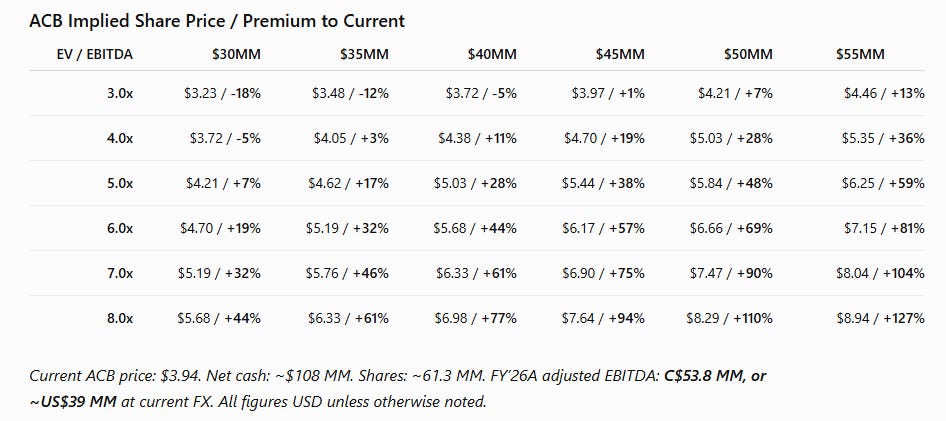
That optionality matters because ACB is really cheap to the right buyer. Yes, FY’27 will be materially lower, but for an acquirer that’s only part of the equation. Layer in synergies—which are likely understated—and you can quickly rebuild something close to the FY’26 earnings base while acquiring scarce, strategic assets. And critically, you avoid the capital, time, and execution risk of trying to build that infrastructure yourself—which is effectively a non-starter today.
Here’s a quick sensitivity on EBITDA and the multiple:
6/ BIGGER PICTURE
Whether Curaleaf ultimately gets Aurora or not, the architecture makes sense. And perhaps that’s the broader takeaway. It’s yet another example of Cannabis 3.0 taking shape—where highly divergent paths are beginning to emerge.
And that divergence is already visible:
Trulieve carving off assets to lean further into medical and facilitate an industry first NYSE uplisting;
GTI channeling the Oracle of Omaha backed by customer-first brands, while consolidating RYM to preserve significant optionality armed with a differentiated currency;
Glass House moving weed outside CA and leapfrogging the interstate debate entirely;
Vireo hoovering up cheap assets to become a member of the $1BN revenue club and soon-to-be one of the largest U.S. dispensary networks; and now
Curaleaf making a bigger bet on international medical cannabis.
Different hands. Different strategies. Different architectures.
7/ HOW TO EXPRESS A VIEW
There are several ways for an investor to play this situation depending on your view: