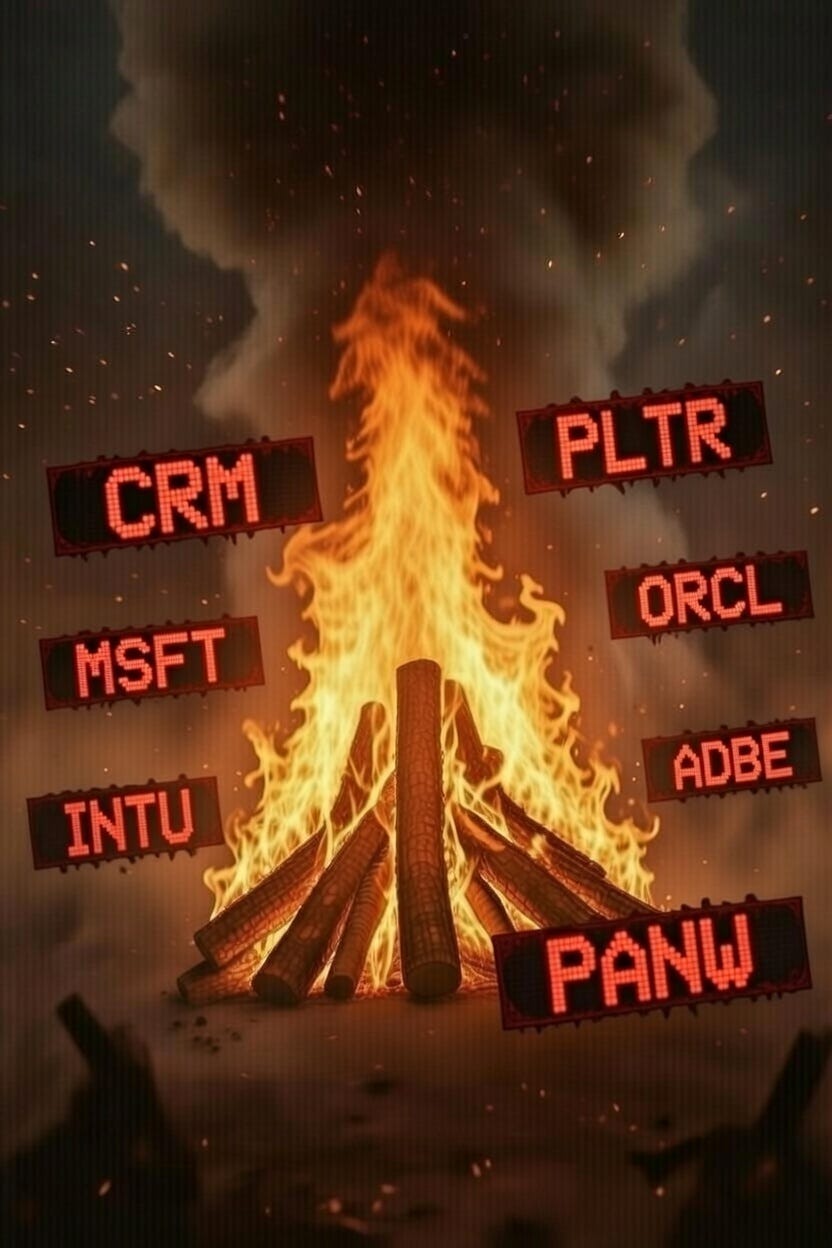
SOFTWARE SLOP
How Software "Eating the World" Ended Up Eating Itself

When the puck moves, you have no choice but to skate to it. So we’re calling an audible: I’m interrupting our bi-monthly SESH cadence and planned content roadmap to briefly touch on a topic that’s clearly on everyone’s mind: software. (Yes, I closely follow the narrative—gauging global investor sentiment, capital flows, and positioning is “table-stakes” for any Corp Dev role. And yes, I promise in my next SESH to focus on weed as we’ll be past earnings, and I’ve been aggressively repositioning cannabis exposure.)
I’ve been very clear in Sunday Sesh that I’ve been highly skeptical on software as these transformational forces move from the “periphery” to the main stage. On X, I left chunky breadcrumbs. For paying subs, I gave you the entire loaf. Some examples you hopefully digested:
In late 2024/early 2025, I completely exited my largest position in Spotify. Despite a clear winner in an expanding digital music TAM, I saw exuberance and “nothing can go wrong” attitudes from the same skeptics that called me crazy for buying Spotify before it went vertical. Today, Spotify is 35% lower than my exit.
By mid-2025, I made it clear I was tilting the book away from technology and software in favor of healthcare, and later PMI-sensitive sectors like energy and industrials. Since June, XLV (Healthcare) is up +21%, XLE (Energy) +25%, XLI (Industrials) +15%….and the IGV (Software) is now down roughly -25%.
Then in Q3 2025—since Beta scares the shit out of me where software + communications comprise 40% of Beta—I shorted software and the MAG7 directly tied to this unfolding AI catalyst. Not because they aren’t great companies. They are. But because everyone thought they were great companies. Since November, the IGV is now down ~30% while the MAG7 is -9%.
As always, Zig when they Zag.
While I’ve spent decades investing in software—especially consumer software across the capital structure, both public and private—I’m humble enough to know definitively I simply can’t compete with a Citadel software PM playing their game. That just means I must play a very different game, one they structurally can’t express.
So what am I doing now? Am I picking up diamonds? Covering shorts? Are there cannabis software names caught in the downdraft that deserve a look?
So roll up a fat J—maybe reach for something cerebral—and let’s get into it. SUNDAY SESH is in session.
2/WHAT THE F*CK IS GOING ON
Software’s re-rating is highly symptomatic of other secular “oh shit” situations I’ve lived through firsthand. Big-box and physical retail vs. online and Amazon, fueled by software and related APIs. Physical newspapers and linear media vs. the digitalization of content, powered by edge devices (like Apple) and software-native platforms like Meta, X, TikTok and Snapchat. To me, what’s happening in software right now isn’t new. History doesn’t repeat, but it sure as hell rhymes.
So let me give you a no-bullshit situational awareness of what’s going on:
Software didn’t sell off this week because demand collapsed. It sold off because certainty did. For over a decade, high-quality SaaS was treated like a bond: predictable, long-duration free cash flow streams that justified lofty multiples fueled by the narrative that “software will eat the world.” AI shook that thesis. Not by breaking the current model (yet?), but by injecting a fog of war into what those future cash flows look like. When investors can’t model duration, they reprice it hard. That’s why stocks got cut in half without earnings imploding. The implication isn’t “software is dead.” It’s that generic, seat-based SaaS just moved into the “too-hard” bucket. And the path to re-rating now runs through proof, not promises: accelerating core revenue, AI-driven expansion, and durable free cash flow in an AI-augmented world. Narrative alone doesn’t get you paid anymore. My variant view: those lofty 8-10x revenue multiples are likely never coming back.
The more unsettling take goes further. AI doesn’t just compress multiples. It may suppress the total software spend itself. For decades, enterprises bought SaaS because building in-house was expensive, slow, and risky. AI flips that equation. When workflows can be created, modified, and orchestrated by agents at near-zero marginal cost, the market for buying software shrinks rather than rotates. Add in the speed mismatch, where AI iterates continuously while incumbents ship quarterly, and emerging compute constraints, and you get a regime shift. Value migrates away from bloated application layers and toward infrastructure, energy, hardware, and the small set of software platforms with real data moats, deep workflow lock-in, or unavoidable network effects. This isn’t a blanket call. It’s a redistribution of hundreds of billions in market cap. Selection, not sector exposure, is everything. My variant view: SaaS earnings won’t implode, but sales cycles will lengthen, pricing pressure will intensify, and every scratch in public markets will turn into a hemorrhage as nervous investors question everything.
There’s a ton of super intel out there—again, don’t wait for the slow-moving Street. Your job, as always, is to curate it. Here are two must-watch conversations this week that best informs how I’m thinking about software .—Jordi Visser (as always), and Brad Gerstner on All-In podcast.
3/WHAT AM I DOING
What am I doing now?
First, Credit leads Equity. Always.
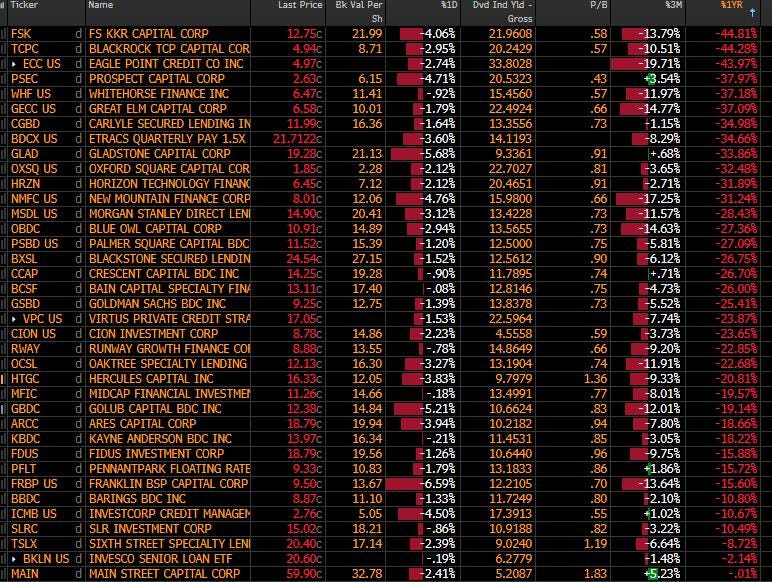
Before you can even get your arms around software equities, the debt capital markets have to stabilize. That’s where I’m focused first—SAFETY—especially as I watch BDCs implode that have “modest” software exposure (see below chart). In case you’re wondering why, I helped launch and scale Solar Capital ($SLRC) while at Magnetar that we eventually took public in 2010. I know the game and the players. While I’m definitely stale, I’m now hand-sifting BDCs that throw off healthy double-digit dividends with ample coverage and debt capacity; trade at meaningful discounts to book; have limited software exposure; and sit in perfected senior-secured, first-lien position across highly cash-generative, well-diversified portfolios. Blackstone’s BXSL 0.00%↑ is the cleanest expression of that for me today—I’ve already bought some. Premier sponsorship, sub-30% software exposure, larger and more durable portfolio companies than peers, and a capital stack where Blackstone sits at “dollar one” within businesses that still trade at mid-teens free cash flow multiples. If software companies hit the wall—not my base case anytime soon—I’m comfortable Blackstone is likely money-good.
Below is a good overlay of how much destruction we’ve seen in this small pocket of the capital markets.
Second, Cover Shorts.
I’m doing this now. The short worked. It’s been a very productive tilt, and I know when I’m overstaying my welcome. I’m not here to play the “pro game” once the same trade I identified a year ago starts becoming consensus thinking. And firms like Citadel and Jane Street will pounce crowding folks like me out. I’m also contemplating covering more of Palantir in the STUPIDITY sleave.
Third, Prepare To Catch Falling Knives.
This is the hardest part. There are businesses I’ve owned before and still have enormous long-term conviction in like Netflix, Spotify, and Shopify. There are also SaaS names I’ve previously owned like Monday, and cybersecurity names like CrowdStrike that I believe will actually grow through this AI fear. I’m sharpening the pencil on all of these in my downtime and will likely pick a few over the next six months as the dust settles. I don’t care about catching the bottom tick, I care about catching the bottom multiple. I want to see the “white in the eyes” from core investors—not sure I’ve seen it yet. But we’re definitely due for a bounce. So traders, get ready.
It’s worth mentioning Weedmaps (MAPS). Now down 40% from December, it has been thrown out with the rest of software and cannabis. It’s not on my must-have list in the sector, but the stock is getting stupid cheap relative to what the business actually is. This is a cash-rich, category-defining platform that still sits at the center of consumer discovery and retailer workflows, yet it’s being priced like it has no future. When things get indiscriminately sold, you don’t need perfection. You just need the downside to be wrong. Don’t own it yet, but on my very short cannabis list.
Fourth, Press The MAG7 Short.
That’s an entirely different bet. I’m pressing it, as I get bigger in some of the MAG7 like Amazon. Flip back to my prior Seshes for more reasoning behind this.
4/END
This isn’t about calling a bottom or forcing a narrative. It’s about positioning for a regime shift in real time. Credit first, discipline second, patience third. Software will produce incredible businesses again, but the entry points will be earned, not gifted. Until then, I’m getting paid to wait, cleaning up what worked, and preparing for what’s next.
Big ideas take time. So does capital.
Onward,
SUNDAY SESH