
WE TRUSTED THE WRONG SYSTEM
How The Endocannabinoid System Reframed Cannabis

One of the biggest ironies of the futile War on Drugs was that in trying to prove cannabis was uniquely harmful, prohibitionists helped catalyze the science showing the plant may be uniquely beneficial.
What began as a rogue plant ended up unlocking an unknown biological system already inside us. Unlike most drug discoveries built to address a specific indication, humans stumbled on the cannabis plant over 10,000 years ago with little understanding of why it worked the entire time.
The first major scientific breakthrough came in 1963. Raphael Mechoulam and Yechiel Gaoni isolated CBD and then THC, cannabis’ primary psychoactive compound. Those breakthroughs mattered because it turned cannabis from a mystery into chemistry. And once they did, scientists found something much more profound.
In 1988, researchers then identified a cannabinoid receptor in rat brain tissue—what we now call CB1. That was the unlock. Because once scientists established that the brain had a receptor specifically responsive to cannabinoids, the obvious question became: why would the body have a receptor for a plant compound at all?
The answer came in 1992, when Mechoulam’s group identified anandamide, the first endogenous cannabinoid—a naturally occurring compound produced by the body that binds to cannabinoid receptors. They named it after the Sanskrit word ananda, meaning bliss.
In other words, the body was already making its own cannabis-like messengers.
Researchers then identified a second cannabinoid receptor—CB2—and in 1995 Mechoulam’s team identified 2-AG, a second major endocannabinoid that would prove even more abundant than anandamide.
By the mid-1990s, the full outline of the endocannabinoid system (“ECS”) was emerging just as the culture was beginning to rethink—or rediscover—cannabis.
To me, this is not a coincidence.
On one hand, we learned our body was biologically wired for cannabinoids. On the other, culture was beginning to figure out in real-time that the government’s 80+ years of propaganda may have been a lie all along. Throw in targeted racism and xenophobia, and it becomes obvious why the fight we see today was inevitable.
So let’s break out the dab rig and get into the ECS—because once you understand the system, the old and tired labels start to fall apart.
Welcome to SUNDAY SESH. This SESH is on me.
ECS: WHAT IS IT?
Picking back up from above, a few brave pioneers pushed forward and proved the ECS is not fringe science. It is a complex cell-signaling network involved in maintaining homeostasis—or balance—throughout the body. As mentioned, your body already produces these cannabinoid-like compounds—such as anandamide and 2-AG. These compounds are released, bind to receptors, and are then broken down by enzymes. The system is constantly working to maintain equilibrium. CB1 is concentrated heavily in the central nervous system and brain, while CB2 is associated with peripheral tissues and immune cells. That is why the ECS shows up in conversations ranging from cognition, appetite, pain, inflammation, mood, pleasure, and broader systemic regulation.
Similar to these natural compounds found in our body, the natural cannabis we consume is biologically wired to work with the same embedded ECS. Whether you’re a person of faith or science, it’s worth emphasizing that our bodies were “engineered” to oddly work with a random plant that naturally grows across the globe.
The point is: your body already makes “keys” for these receptor “locks.” Cannabis—like the endogenous cannabinoids inside your body—simply open the same locks.
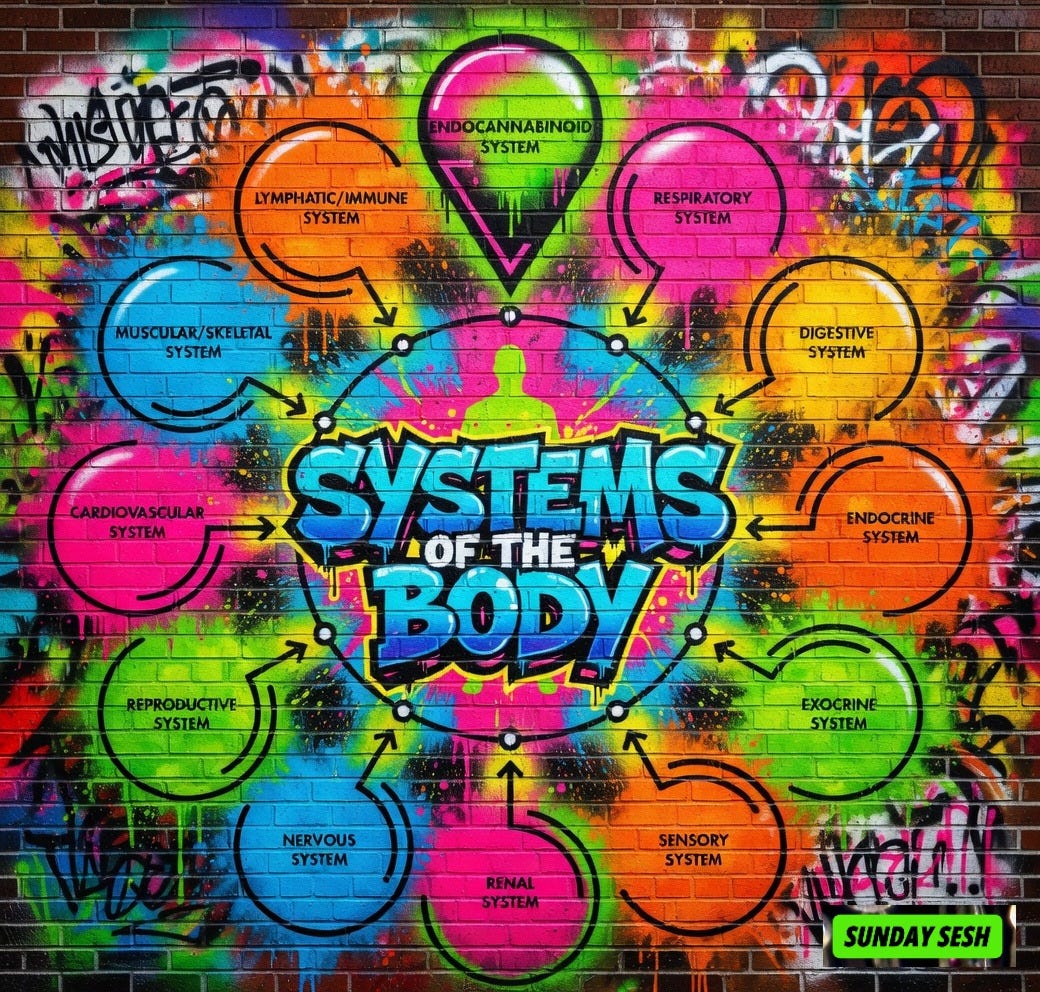
Unlike the other 11 major systems in our body—like the circulatory, nervous, digestive, and endocrine systems—almost no one is taught about the ECS in medical school. And yes, even today, that includes many of the world’s best medical institutions training tomorrow’s best doctors.
Think about that for a second—the best doctors in the world never learn about one of the body’s major systems discovered over 30 years ago. That’s like training a heart doctor, but skipping over the sections on cholesterol and statins.
ECS: WHY IT MATTERS
Once you understand that your body already “speaks” cannabinoids, the lazy framing around cannabis starts to collapse. This is not some random outside substance smashing into the body from left field. This is a plant whose active compounds interact with a pre-existing biological system that exists for a reason.
That does not mean cannabis is harmless, perfect, or universally good. Of course not.
It means the plant is working through a physiological architecture already central to human regulation. From my seat, that is one of the most underappreciated truths in the entire category. Is it medicine? Is it wellness? Is it supplementation?
One thing is clear—cannabis isn’t the devil’s lettuce.
When you accept that the human body has an endocannabinoid system whose central role is to help regulate balance, a lot of the old propaganda starts to look even more ridiculous than it already did.
SUBSTITUTION
What makes this even more interesting is how cannabis differs from alcohol at a biological level. Alcohol does not interact with a dedicated, body-wide regulatory system the way cannabinoids do. Instead, it works more bluntly—through complex interactions with multiple neurotransmitter systems, including GABA and glutamate, effectively slowing and dysregulating neural signaling across the brain. That is why alcohol lowers inhibition and impairs coordination, memory, and judgment in a relatively non-specific way. It is broad neural disruption, not targeted modulation through a homeostatic signaling network.
Given this dynamic, it’s no surprise that alcohol can have many painful side effects. Why? Because our body wasn’t built for throwing back rounds of booze. One night of heavy drinking makes that point all too familiar.
Cannabis, by contrast, is interacting with a signaling system the body already uses. To be clear, that does not mean cannabis is “harmless” nor does it say that every use case is smart or benign, especially for youth or at-risk consumers.
But it does make it fundamentally different nevertheless. Alcohol works more like broad neural override. Cannabis modulates a system that already exists. From a consumer and category standpoint, that distinction matters more than most people realize.
This also helps explain why cannabis shows up across so many different consumer use cases. People do not just use it for one thing. They use it for sleep, stress, appetite, pain, inflammation, recovery, mood shifting, social lubrication, focus modulation, and general recalibration. That diversity of use has always confused outsiders who want cannabis to fit into one neat box: a dangerous drug with no health benefits.
WHAT’S IN IT FOR US?
This is also where smart operators and investors need to think harder. Because if cannabis is interacting with a body-wide balancing system, then product architecture matters enormously. Indication matters. Dose and onset matter. Form factors and quality matter. And in the end state, consumer education and trust will greatly matter.
The difference between a low-dose, fast-onset beverage or gummy, a combustible joint, and a high-potency concentrate is not just branding. It is user experience mapped onto physiology. That is why I continue to believe the category gets more interesting—not less—as it becomes more precise and more CPG-like where THC and other cannabinoids become ingredients. The result of that will be an explosion of use cases that we are barely scratching the surface on today.
And as these get figured out, new multi-billion dollar TAMs will be created instantly.
Let me give you two personal examples.
While I still maintain a prescription for Ambien, I’ve mostly swapped it out for cannabis more than a decade ago for numerous reasons. Similarly, when I’m home sick with a nasty flu or cold, I reach for a super high-quality RSO or rosin gummy or 6-star dab instead of dosing with Nyquil. It’s not even a debate anymore. These two categories alone exceed $65 BN in TAMs—and while I’ve known about these alternatives “forever” even a guy like me simply didn’t have access to them (especially RSO). Now I do. And so do hundreds of millions of people around the globe.
It also signals why the future of cannabis will not be won by the loudest people yelling “legalize it” as if the work stops there. Legalization is just the first unlock. The bigger opportunity is building products, brands, channels, and experiences that respect how people actually use cannabinoids in the context of real life. Sleep is different from social. Recovery is different from recreation. Calm is different from euphoria. Daily low-dose is different from weekend overconsumption.
A category built on top of the ECS should ultimately become more segmented, more targeted, and more intelligent over time. That is what mature consumer categories do when they stop being defined by stigma and start being defined by users.
The future is here.
CONCLUSION
For decades, cannabis was framed by the government as a devil frying our brains, making us crazy, and even stealing our women. Ironically, that erroneous view held by prohibitionists helped fund and prove their own lunacy. Clearly, the science then and now points to a very different reality.
As an activist in the space, I—like others—tend to take this truth for granted. When you step outside the “cannabis bubble” it’s very clear the mainstream conversation on cannabis is still centered on validating—or rejecting—80+ year old lies.
But that is on the verge of dramatically changing. With continued regulatory progress, practitioners will begin to study the plant without reputational and career risk. And my view is that future unlocks will be staggering. My strong thesis is that this work will validate decades of “bro science” I’ve personally experienced now over 30 years. I’m personally most optimistic about cannabis’ impact on inflammation (see above regarding colds/flu).
Because once consumers understand that cannabis is not merely about intoxication—but about interaction with a real endogenous balancing system—the category opens up in a very different way. It stops looking like a binary debate between “drug” and “medicine” and starts looking like what it actually is: a broad consumer and wellness category with deep biological roots, wide use-case potential, and a regulatory framework that still badly lags reality.
Which is why I keep coming back to the same idea in different form: we trusted the wrong system.
And your body already knew that. The world is just starting to catch up.
Onward,
SUNDAY SESH
***Disclaimer: Not financial or investment advice, do your own work; this is intended for sophisticated investors. No conflicts, no MNPI, these are my own opinions, and no representation that what’s presented is accurate. As disclosed, authors of SUNDAY SESH hold common shares and derivatives of companies mentioned and they have no obligation to update or disclose changes. No representation is made as to accuracy or completeness. Past performance is not indicative of future results. And as always, cannabis was used frequently in the authorship to creatively solve problems. Know what you own.